

Fast fashion, plastic fabrics, and the unseen energetic cost of what we put on our skin.
What You Wear Is Either Feeding You — Or Draining You
Fast fashion has trained us to value cheap, quick, trending.
But rarely do we stop to ask a deeper question:
What are our clothes actually doing to our bodies… and our energy?
Most modern clothing is made from plastic — polyester, nylon, acrylic, spandex — all derived from petrochemicals. We wear them daily, often for hours, directly against our skin. And our skin isn’t just a barrier.
It’s our largest organ.
🧠The Science (What We Know So Far)
Bioenergetic research has explored the idea that materials carry measurable energetic properties.
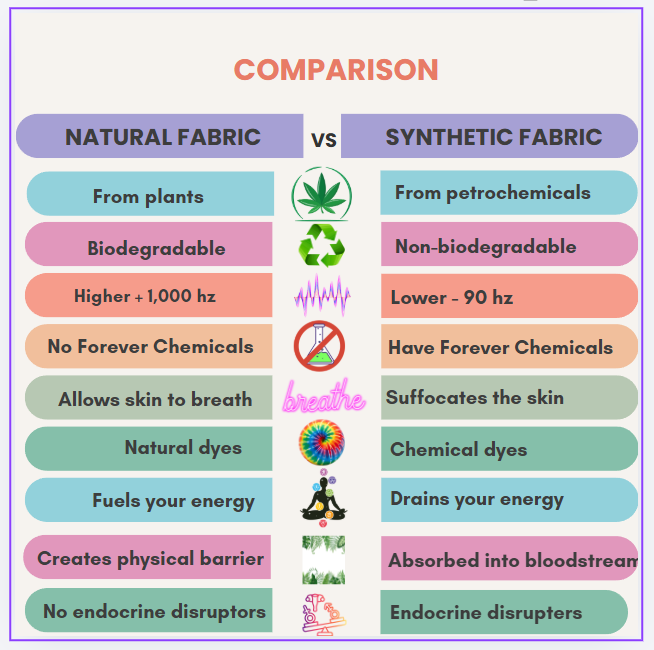
In 2003, Dr. Heidi Yellen researched using an Ag-Environ bioenergetic testing device and measured the energetic resonance of fabrics. The findings suggested a striking contrast:
- Natural fibres (linen, wool) showed high energetic readings
- Synthetic fibres (polyester, chemically processed bamboo) showed very low readings
While there is currently no globally recognised scientific unit to certify “frequency” in clothing (the way GSM measures fabric weight), the pattern is consistent:
👉 Natural materials support coherence.
👉 Synthetic materials create interference.
Common sense, right?
When energy grows, energy flows, and the body functions better.
When you feel blocked, fatigued, and brain fogged, an imbalance appears.
👕Your Body & What It Resonates With
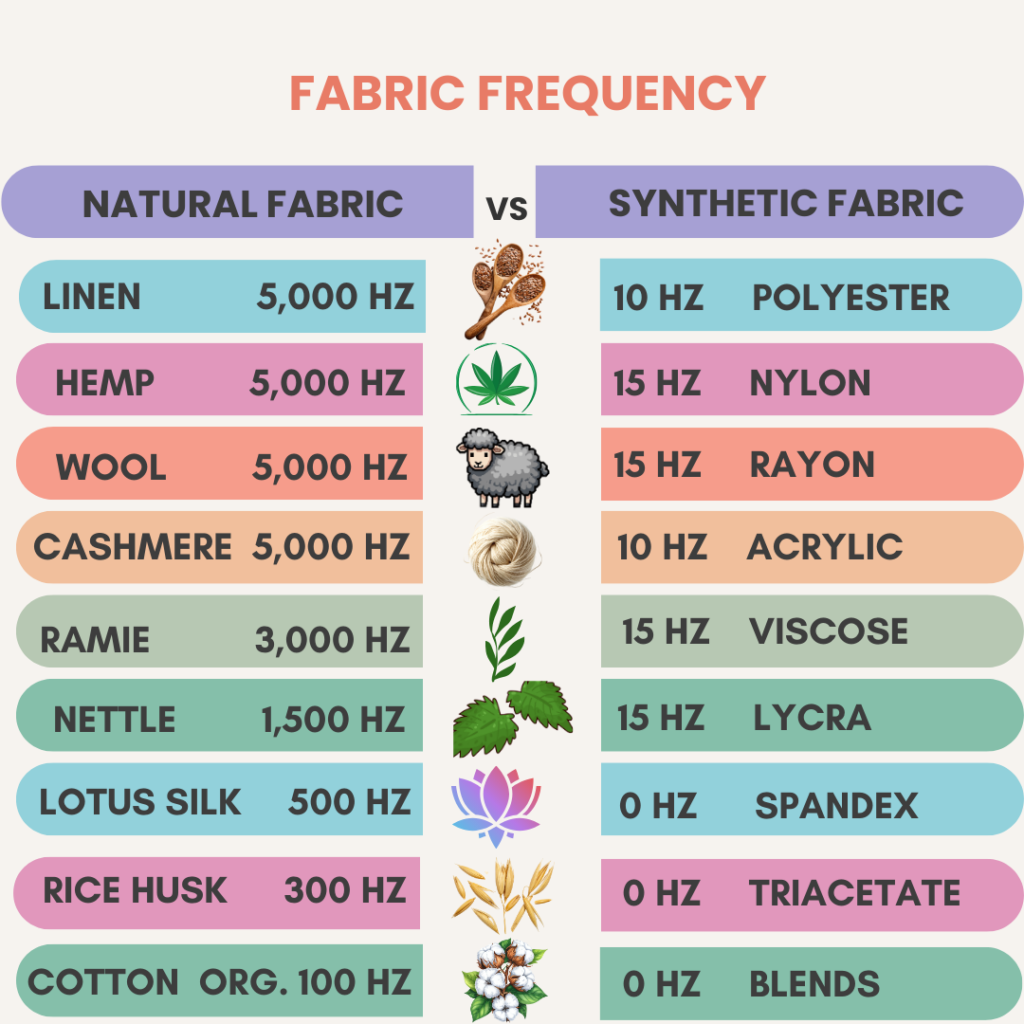
The human body operates as a bio-electric system, resonating around 100 Hz.
Interestingly:
- Organic cotton resonates close to 100 Hz, same as the human body
- Linen & wool are measured much higher 5,000 Hz
- Polyester drops close to 15 Hz
In homeopathic medicine, there’s a foundation principle, developed by Samuel Hahnemann in the late 18th century, this principle suggests that “Substances producing symptoms in the healthy can treat similar symptoms in the sick”:
“Like cures like.”
So maybe it’s not so far-fetched to ask:
Is the body more at ease when it’s wrapped in something that resonates with it — rather than against it?
🌍Fast Fashion, Fast Consequences
In a world driven by instant gratification and image, it’s uncomfortable to question the cost.
I question myself too.
What example am I setting for my teenage daughter?
What hormonal and endocrine stresses are we regarding as normal — especially for young bodies still developing?
With rising chronic illness, hormonal disruption and environmental toxicity, should we not also be asking:
What are “forever chemicals” and plastic fabrics doing — not just to our planet, but to our bodies?
🌿Frequency by Design — Not Hype
High-frequency clothing isn’t a trend.
It’s a return.
A return to fibres that:
- come from plants or animals
- breathe with the body
- regulate moisture and temperature
- ground the nervous system
- allow energy to move, not stagnate
Natural fibres don’t trap static electricity.
They ground.
Linen has historically been used in:
- hospitals
- wound care
- bandages (bacteria struggles to survive on it)
- ancient ceremonial rituals and Egyptian mumification
Across cultures and even sacred texts, mixing fibres was discouraged — not as superstition, but as energetic wisdom.
🧵Fibres That Hold Coherence
High-frequency fibres:
- 100% Organic Cotton (GOTS-certified)
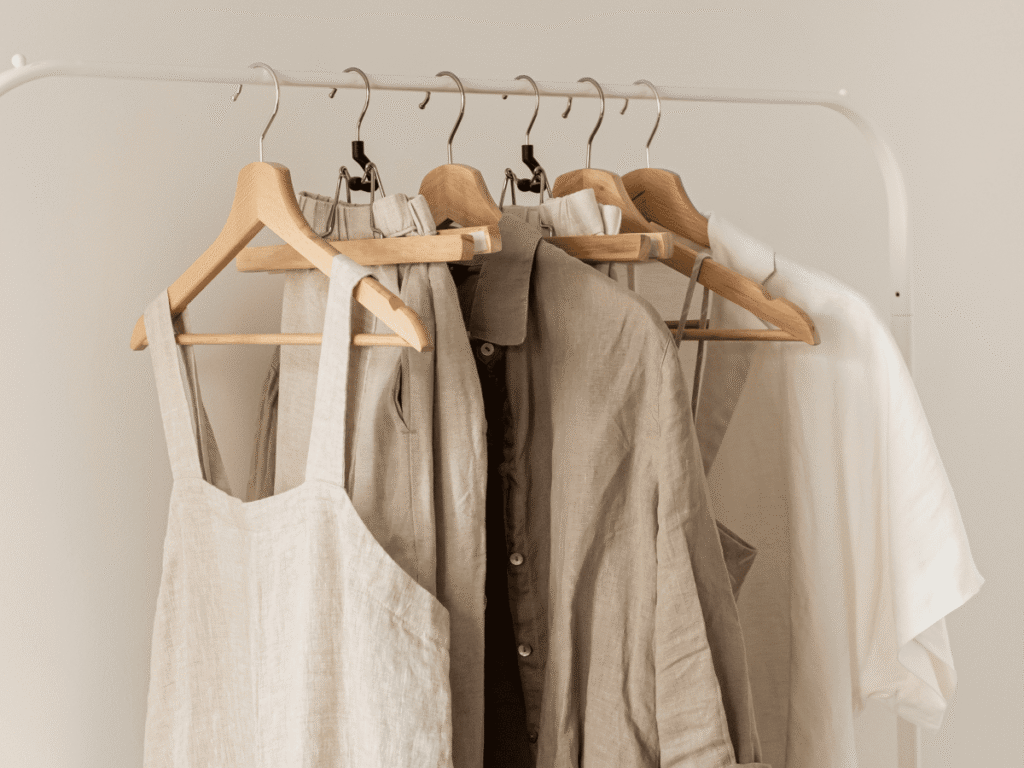
- 100% Linen (flax-based, enzyme-retted)
- 100% Wool (non-mulesed, low-chemical processing)
- Hemp, nettle, ramie
What to avoid:
- ❌ Blends
- ❌ Polyester, nylon, acrylic, spandex
- ❌ Recycled plastic masquerading as “eco”
If your clothes come from plants or animals, they carry life force.
If they come from highly processed oil… they don’t.
🧘♀️ Clothing as Your Second Skin
Clothing is our second skin.
And just like food:
- What you put in nourishes you
- What you put on can either nourish or drain you
Synthetic fabrics shed micro- and nano-plastics, which are now found crossing the blood-brain barrier and acting as hormone disruptors.
We already deal with enough interference.
Why add more?
✨The Spiritual Layer (The Part We Feel)
You don’t need a machine to feel this.
You already know.
Have you ever:
- owned an outfit that looks beautiful but feels “off”?
- felt instantly calmer in linen or wool?
- felt tired, foggy or irritated in certain clothes?
Try this:
Go to your cupboard.
Close your eyes.
Touch a few garments.
Feel the difference.
If it feels alive — it is alive.
You are not meant to be an energy blocker.
You are a receiver.
🌱A Conscious Choice
High-frequency clothing isn’t about perfection.
It’s about awareness.
Choosing:
- fewer pieces
- better materials
- ethical, human-centred production
- garments that honour body, planet, animals and energy
Fast, cheap and trending
vs
Clean, conscious and coherent
🧡Final Thought
Nature knows how to care for you.
Cover your body in what comes from the earth —
like wrapping yourself in a blanket of love.
If linen is our super fabric,
maybe it’s time to switch our superpowers back on.
Choose consciously.
Your body — and your soul — already know.