
Home & Kitchen · Air Fryers
Everyday appliances,
Everyday Exposure
Air fryers have transformed the way we cook — faster, crispier, with less oil. But most conversations stop at convenience. What we rarely discuss is what happens to the materials inside when temperatures climb past 200°C, and what that means for what ends up in our food.
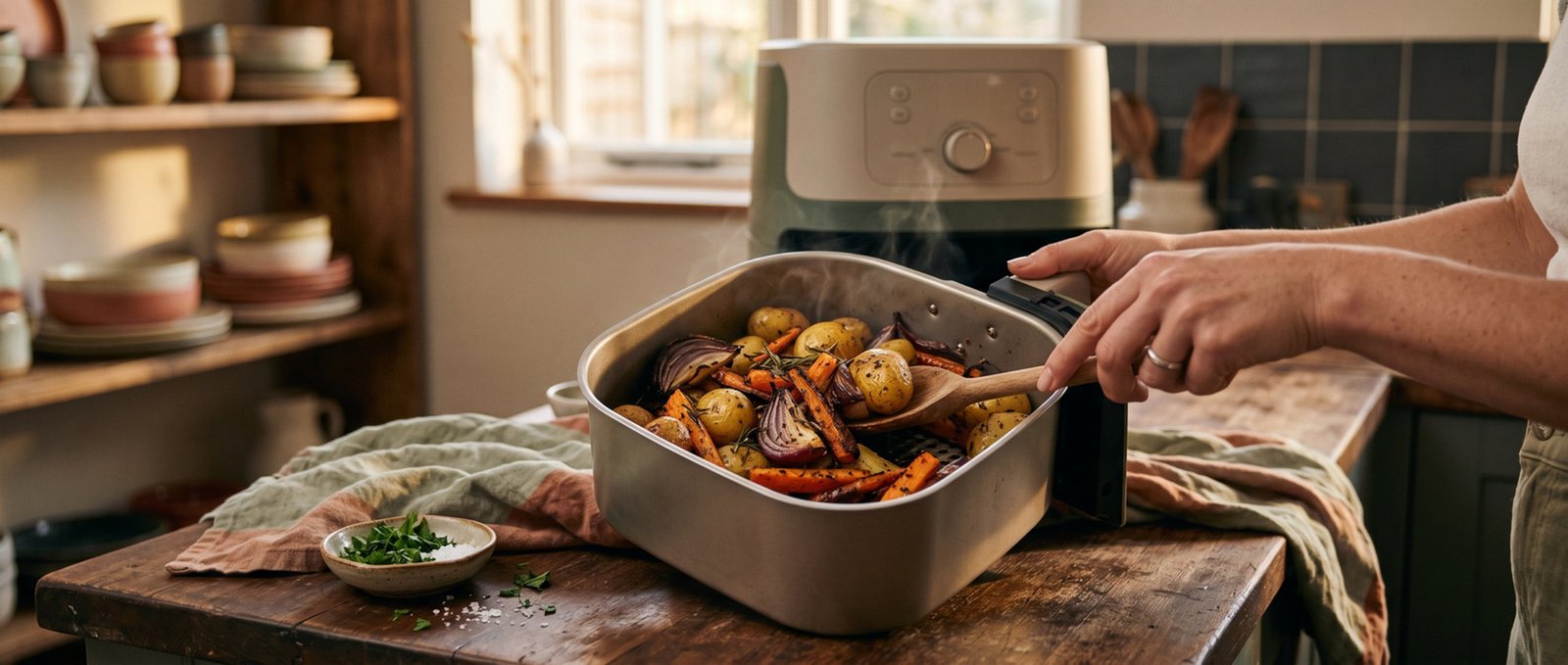
It was never about the appliance.
Air fryers are usually defended or attacked on what they do to food. We went looking for the evidence, and found that the food question is mostly settled — and mostly not where the interesting part is. Three things govern what survives cooking: how much water touches it, how hot it gets, and for how long. The box it happens inside barely registers.
| Method | Water-soluble nutrients |
& AGEs |
Added oil |
|---|---|---|---|
| Wet heat — capped near 100°C | |||
| Steaming~100°C · no water contact | Best retainedOnly method tested on broccoli that didn’t significantly cut vitamin C | None formBelow the browning threshold | None |
| Microwaving~100°C · little or no water | Best retainedPreserved vitamin C best across the vegetables tested | MinimalBarely browns, so barely forms them | None |
| Boiling100°C · full water contact | Worst retainedGreatest losses of , flavonoids and antioxidant activity of any method tested | None formLowest AGEs of any method | None |
| Dry heat — 180°C and above, where browning begins | |||
| Air frying180–200°C · forced hot air | Well retainedBest or near-best on phenolics, flavonoids and antioxidant capacity in brassicas | They form — and the range is enormous42 to 1,598 µg/kg acrylamide in the same machine, on time and temperature alone | MinimalUp to 15× less than deep frying |
| Oven roasting180–200°C · convection | Well retainedSame mechanism as an air fryer, slower fan | They formRoasted chicken with skin: 8,244 AGE units. Boiled: 1,123 | Low |
| Pan fryingUncapped · direct contact | Not testedNo study we found measured this | Highest AGEs measuredPan-fried beef: 10,058 AGE units — the top of the reference database | Moderate |
| Deep frying175–190°C · oil immersion | Not testedNo study we found measured this | They form649 µg/kg acrylamide in one controlled comparison | Highest |
Scroll sideways for all four columns →
Three things this table quietly demolishes.
“Air frying destroys nutrients.” It doesn’t. Nutrient loss in cooking is mostly leaching, and an air fryer uses no water at all. On phenolics and flavonoids it beat boiling comfortably. Boiling — the method that sounds gentlest — came last.
“Air fryers make more acrylamide than deep fryers.” That headline came from a single study whose own authors reported no statistically significant difference, and every value it measured fell below its own detection threshold. It was formally rebutted in the same journal. In a properly designed comparison, the same air fryer produced 47% less acrylamide than deep frying at one setting and 2.5× more at another. The dial is the variable, not the machine.
“An air fryer is basically a microwave.” They’re near opposites. A microwave heats water and stops around 100°C, so it barely browns — which is exactly why it forms so little of what the middle column measures. An air fryer is built to brown. On nutrients, the microwave generally does better.
There is a real finding here, and almost nobody is reporting it. When sardines were air-fried, cholesterol products rose from 61.2 to 283 µg/g — a 4.6-fold increase — and essential fats fell significantly.
The mechanism is the appliance’s entire selling point. High- hot air across the whole surface of the food is close to ideal conditions for oxidising fat. The oil bath in deep frying can actually be protective, because it keeps oxygen off. Adding fresh herbs to the fish before cooking reduced the effect measurably.
So if there is a case to make about air fryers and food, it is about oily fish, not potatoes.
Sources. Cooking method and vegetable nutrients: Erim & Binici, Chemical Papers 2026; Lee et al., Food Science and Biotechnology 2018; Yuan et al., J Zhejiang Univ Sci B 2009. Acrylamide: Dong et al., Frontiers in Nutrition 2022; Navruz-Varlı & Mortaş, Frontiers in Nutrition 2024, and Serdar’s rebuttal in the same journal, 2024. AGEs: Uribarri et al., J Am Diet Assoc 2010. Oil content: Téllez-Morales & Arce-Ortiz, Sustainable Food Technology 2024. Cholesterol oxidation in sardines: Ferreira et al., Journal of Food Science 2017. AGE figures are reported in kU per 100 g as published; the assay behind them reads higher than mass spectrometry, so treat them as directional rather than exact.
What to be mindful of
When heat meets material,
the conversation changes.
Air fryers are used daily — sometimes multiple times a day. Understanding the materials involved in high-heat cooking helps us make choices that support long-term wellbeing, without requiring perfection.
Non-stick coatings under heat
Many air fryer baskets are coated with PTFE-based non-stick materials. PTFE begins to break down above 280 °C, where it releases fumes — a figure the Merck Veterinary Manual and Cornell University College of Veterinary Medicine agree on. That is the temperature at which breakdown begins; it is not a promise that anything below it is fine. What is easy to miss is that an air fryer does not get there. When ten domestic models were measured against their own dials, every one ran at or below its setting — up to 38 °C below at 200 °C. A frying pan on a hob is the appliance that reaches 380 °C and more, within minutes. The coating question here is about wear and disclosure, not heat.
Plastic components & circulating heat
Air fryers use a fan to circulate hot air at high speed. When plastic internal components are exposed to sustained heat, there is potential for low-level . This is rarely discussed, but worth understanding when evaluating daily-use appliances.
Basket material composition
Beyond coatings, the base metals used in baskets matter. Lower-quality may contain trace compounds that behave differently under sustained high heat. Material transparency from manufacturers varies significantly across the market.
Repeated daily exposure
A single use creates minimal concern. But air fryers used once or twice daily, every day, represent significant cumulative exposure to heat-reactive materials. Conscious material choices matter most in the tools we reach for habitually.
What to look for
Conscious alternatives exist.
The goal isn’t a perfect air fryer — it doesn’t quite exist yet. The goal is to move toward options that reduce unnecessary material exposure, offer greater transparency, and align with the way Shake thinks about daily tool selection.
Stainless steel baskets
An uncoated surface removes the coating question rather than reducing it. Be warned that the phrase is doing a lot of work in this category: “stainless steel air fryer” almost always describes the outside of the box, and the one basket-format model we found advertising a stainless basket has a ceramic coating over it. Ask what the food actually sits on.
Honest language about coatings
PTFE is itself a PFAS — Teflon and are two of the names it goes by. A PTFE coating cannot be PFAS-free, whatever a listing says. Removing PFOA from the manufacturing process was a real improvement, and it is a different claim from the one the words suggest. If you want the coating question gone rather than reduced, the answer is a surface with no coating on it.
Material transparency from brands
Look for brands that openly publish information about their basket coatings, internal materials, and safety certifications. Transparency is one of the most telling indicators of conscious manufacturing.
Oven-style vs basket models
Oven-style air fryers with wire racks and stainless steel interiors naturally avoid many basket coating concerns — a practical middle ground between a conventional oven and a compact air fryer.
Temperature mindfulness
Keeping temperatures at or below 200°C where possible reduces material stress. Most recipes work beautifully below 200°C — a simple habit that extends appliance life.
Convenience should not
Compromise Health
Featured Brand
We have not found one.
Before Shake will feature an air fryer, we ask the brand five questions. They are not hard questions. A company that makes the thing knows all five answers.
- 1 What is the basket made of underneath the coating?
- 2 What is the coating, named by its chemistry rather than its marketing? “Ceramic” and “non-stick” are not answers.
- 3 Who makes the coating, and has an independent laboratory tested the food-contact surface for total organic ?
- 4 How many cooking cycles should the coating last, and what should you do once it is scratched or worn through?
- 5 Are replacement baskets sold — at what price, and for how many years after the model stops being made?
We put all five to four brands and read everything each one publishes. The best answer was two out of five.
Answered, out of five
Philips 2 · Instant 2 · Cosori 2 · Breville 0
Not one has published how long its coating lasts. Not one has published a fluorine test. Not one will commit to selling you a replacement basket in three years’ time.
So the slot stays empty. This is not a boycott, and it is not a judgement on how well any of these machines cook. It is simply that we will not put a brand in this position on the strength of a product page. If you make air fryers and you can answer all five, we would genuinely like to hear from you.
What each brand will tell you
Four brands, and what they say out loud.
None of these is scored yet, and none is presented as a recommendation. What follows is what each company publishes about its own materials — and what it doesn’t. Ordered by how much they are willing to put in writing.
Philips Essential
Discloses its materials · No longer made by Philips
Open Questions. We looked for an independent fluorine test on the food-contact surface, a coating lifespan, and a parts commitment, across the materials page, the product pages and the published disclosures. We could not find them. The score reflects what we could check — nothing more and nothing less.
Publishes the fullest materials page in the category: baskets of steel or aluminised steel, coated with PTFE, with ceramic on some 7000 Series meshes. It names the countries it manufactures in, which almost nobody does. Worth knowing that Philips sold this business in 2021 — the airfryer is made by Versuni under a fifteen-year licence on the name, so Philips’ own environmental record does not cover it.
- Names substrate and coating chemistry — two of our five
- “PFOA-free” is not a PFAS claim. PTFE is a PFAS
- No lifespan, no fluorine test, no parts commitment
Instant Vortex Plus
Says PTFE in its own words
Open Questions. We looked for an independent fluorine test, a coating lifespan, and how long replacement baskets stay available, across the FAQ, the product page and the California chemical disclosure. We could not find them. The score reflects what we could check — nothing more and nothing less.
Instant’s own FAQ states the tray is aluminised steel with a PFOA-free PTFE coating, and its California chemical disclosure lists PTFE, PFA and FEP on the food-contact surface. It also warns the coating is “not suitable for use around birds and small pets”. We rate disclosure, and that is disclosure. The company behind it filed for Chapter 11 in 2023; the appliance arm now sits with a private investment firm and publishes no environmental reporting we could find.
- Names substrate and coating chemistry — two of our five
- The “stainless steel” in the listing is the outside of the box
- No lifespan, no fluorine test, no parts period
Cosori Iconic
Claims PFAS-free · Unverified
Open Questions. We looked for the coating named by chemistry rather than by category, an independent fluorine test behind the PFAS-free claim, a lifespan, and a parts commitment. We could not find them. The score reflects what we could check — nothing more and nothing less. Where we cannot establish what a surface is made of, we score it as the worst thing an air fryer basket is evidenced to be — the same rows, at the same weight, as the two brands here that told us. If it is better than that, one sentence from the brand moves the number.
The only brand of the four claiming an outright PFAS-free ceramic coating on its current models, and the only one to name a steel grade. That is a materially stronger claim than PFOA-free — but no test method, standard or third-party certificate is published to support it, and it covers named models rather than the range. Two million Cosori air fryers were recalled in 2023 over a wire connection that could overheat; the recalled models are not the current ones.
- The only PFAS-free claim here — and the only one nobody has checked
- “Ceramic” is a marketing word, not a specification
- Ceramic coatings tested against PTFE wore out sooner
- The steel grade tells us what sits under the coating, not what touches food
Breville Smart Oven
Discloses nothing
Open Questions. We looked for the basket material, the coating, a test, a lifespan and a parts commitment, across the product pages and the instruction manual. We found none of the five. The score reflects what we could check — nothing more and nothing less. Where we cannot establish what a surface is made of, we score it as the worst thing an air fryer basket is evidenced to be — the same rows, at the same weight, as the two brands here that told us. If it is better than that, one sentence from the brand moves the number.
The oven format is the most interesting answer to the coating question anyone has: open wire racks need no non-stick surface at all. But Breville publishes no material information — its own manual mentions PTFE, ceramic, PFOA and PFAS exactly zero times, and the range ships with a non-stick pizza pan and an enamel roasting pan. This page previously said its stainless interior removed the coating concern. Breville has never said that, and neither should we have.
- Zero of our five questions answered
- Strongest supply-chain reporting of the four — 21 audits published in FY24
- The shape of the thing is promising. The silence is the problem
Material & Ingredient Awareness
Understanding what surrounds your food.
— polytetrafluoroethylene — is the compound behind most non-stick surfaces, often known by the brand name Teflon. At standard cooking temperatures it is considered stable. It begins to break down above 280 °C, releasing inhalable particulates and acidic gases — a threshold the Merck Veterinary Manual and Cornell University College of Veterinary Medicine both put at the same figure. That is where breakdown starts, not a rating for safe continuous use.
— perfluorooctanoic acid — was the chemical historically used to manufacture PTFE coatings. It has been phased out by most major manufacturers following health and environmental studies linking it to various long-term concerns. However, replacement compounds within the PFAS family continue to be researched for similar properties.
The Shake approach to cookware materials is not to generate alarm. It is to provide material literacy — the simple awareness that what touches your food daily, under sustained heat, is worth understanding. Small material choices repeated over years create meaningful cumulative patterns.
“The body doesn’t process a single meal. It processes the accumulation of daily choices — including the materials those meals were cooked in.”
Words on this page
We would rather explain a word than avoid it. Tap any dotted word above, or read them here.
- Acrylamide
- Forms naturally when starchy food browns above about 120°C. Nobody adds it and no brand can remove it from a potato — less browning simply means less of it.
- Phenolics
- Natural plant compounds in vegetables, herbs and fruit, and part of what makes them worth eating. They are lost most to boiling water, not to dry heat.
- Oxidation
- What happens when fats meet oxygen and heat and change their structure. It is why oil goes rancid — and why oily fish is the food most affected by fast-moving hot air.
- Omega-3
- The fats your body cannot make and has to get from food, found in oily fish, flax and walnuts. “Essential” here is a nutritional category, not a marketing word.
- Velocity
- How fast something moves. In an air fryer the hot air travels quickly across the whole surface of the food — which is what crisps it, and also what exposes its fat to oxygen.
- Off-gassing
- When a material releases fumes or vapour as it heats. The “new appliance smell” is off-gassing.
- Alloys
- A metal mixed with other metals to change how it behaves. Stainless steel is an alloy of iron with chromium, and usually nickel.
- PTFE
- Polytetrafluoroethylene. The plastic behind most non-stick surfaces, sold under names like Teflon. It is a fluoropolymer, and fluoropolymers are PFAS.
- Fluorine
- The element at the heart of every PFAS. Testing for total organic fluorine is how a laboratory checks for all of them at once, instead of hunting for named chemicals one by one.
- PFOA
- Perfluorooctanoic acid. One single PFAS chemical, once used to manufacture non-stick coatings and now largely phased out. “PFOA-free” says nothing about the thousands of other PFAS, including the coating itself.
The label writes the score. We don’t. Only evidence moves it.
How these four were scored. All four under the ShakeUp Standard v1.6, together with the rulings of 14 September 2026 that added a service-life ceiling and a silence ceiling for appliances. Every brand on this page caps on the People pillar because none of them answered all five of our material questions. No brand here has any arrangement with Shake, none was given notice, and none saw its score before you did. Any of them can move its number by sending evidence — free, forever, and faster than any other route.
Where the money comes from. We earn a commission from Amazon on the links above, not from the brands. Amazon pays us the same whether we score a product 40% or 95%, so there is nothing to gain from a generous number. No brand on this page paid for placement, imagery or a word of the copy.
Not medical advice. Nothing here diagnoses, treats or prevents anything. We report what manufacturers publish and what the literature finds, and leave the conclusion to you.
Sources. Instant Pot, Cookware Chemical Disclosures (California AB 1200 filing) · Instant Brands, Vortex Air Fryers FAQ · Philips/Versuni article XC000021623 · Cosori Iconic product page · Breville BOV905 Instruction Book (ANZ 2024) · OECD, Reconciling Terminology of the Universe of PFAS, ENV/CBC/MONO(2021)25 · Merck Veterinary Manual and Cornell University College of Veterinary Medicine, on the 280 °C threshold · Campden BRI, Heating characteristics of domestic air fryers, 30 July 2025 · Guerrero-Vacas et al., Results in Engineering 2025;26:105074, on ceramic versus PTFE durability · Ecology Center, What’s Cooking? PFAS and other chemical hazards in nonstick pans · CPSC Recall 23-130, 23 February 2023. All brand documents read 14 September 2026.
High Heat
Changes Materials
You don’t need a perfect kitchen. You need a more aware one.
One thoughtful tool at a time.
Awareness over overwhelm · Clarity over confusion · Conscious choices over blind consumption