But the narrative might be.
Sunscreen
We have spent thirty years being told to fear the sun, and the products sold to protect us from it have never been tested the way you would assume. In 2019 the FDA ran maximal-use trials on six chemical UV filters. All six crossed into blood plasma above the threshold at which their own guidance requires further toxicology work.
That testing still hasn’t happened. Which is not the same as saying these ingredients are dangerous — it is saying nobody has finished finding out. This page is about the difference between those two sentences, and about what to look for while the question stays open.
What the FDA actually found
Six chemical UV filters were tested under real-world application conditions. Every one of them was detectable in blood plasma above 0.5 ng/mL — the level at which the FDA’s own guidance calls for further safety testing. All six now sit on the Shake avoid list. Four of them were added on 4 August 2026, because researching this page exposed a gap in our own list.
| Filter | Tier | Why it’s listed |
|---|---|---|
| Oxybenzone | TIER 1 | Banned from sale in Hawaii under Act 104 on reef-toxicity grounds. Reached 258.1 ng/mL in plasma after a single application — roughly 500× the FDA’s testing threshold. |
| Octinoxate | TIER 1 | Also banned in Hawaii under Act 104. Absorbed above the FDA threshold. |
| Homosalate | TIER 1 | Restricted by the EU to 7.34% and face products only, on endocrine grounds (Reg. 2022/2195). Non-compliant stock off the EU market since 1 January 2025. |
| Avobenzone | TIER 2 | Absorbed above the FDA threshold. Also photo-unstable, meaning the protection it offers degrades while you are wearing it. |
| Octocrylene | TIER 2 | Absorbed above the FDA threshold, and included in the EU’s call for data on endocrine-disrupting properties. |
| Octisalate | TIER 3 | Absorption is established; its significance is not known. Listed for completeness, not because we believe it is harmful. |
Sources: FDA maximal-use trials, published in JAMA, 2020 — jamanetwork.com. Hawaii Act 104 (SB 2571), signed 2018, in force 1 January 2021. EU Regulation 2022/2195.
What to be mindful of
None of this requires a chemistry degree. It requires turning the bottle over.
“Reef-safe” is a marketing term
It has no regulatory definition and no certifying body behind it. Any brand may print it on any bottle. evidence is a document you can request — reef-safe wording is a decision someone made in a design meeting.
“Fragrance” is a legal black box
The word covers a formulation the manufacturer is not obliged to disclose, protected as trade secret. A single entry can stand for dozens of undeclared compounds. If a label says , it is legally permitted to tell you nothing else.
SPF measures burning, not everything
SPF is a UVB number — it describes how long skin takes to redden, not total protection. A high number can encourage staying out longer, which is precisely the behaviour it should discourage.
Some filters degrade as you wear them
Avobenzone is photo-unstable: sunlight breaks it down. Protection measured in a laboratory at application is not the protection you have three hours into a beach day.
Aerosols add a route nobody has mapped
Spray formats create an inhalation pathway that has not been characterised the way skin absorption now has. This is a gap in the evidence rather than a finding — but it is a gap worth knowing about, particularly with children.
Not finished testing is not the same as safe
The FDA has not said these filters are dangerous. It said they are absorbed at levels requiring further study, and asked for that study. It hasn’t been delivered. Both of those sentences are true at once.
What to look for
Good sun care is unglamorous and mostly short. Six things worth checking.
Non-nano zinc oxide
Non- particles are too large to cross the skin barrier, so the absorption route that makes chemical filters a question simply isn’t there. It sits on the skin instead of in you.
Uncoated minerals
Many mineral sunscreens coat their zinc in dimethicone or to improve the feel. Not automatically a problem — but worth knowing, because it is rarely mentioned on the front of the bottle.
A short ingredient list
One active and a handful of carrier oils is a formula you can actually assess. Thirty ingredients is not inherently worse — it is simply harder for anyone, including us, to evaluate.
In-vivo SPF testing
An number should come from testing on skin to ISO 24444 or equivalent, not from calculation. Ask. A brand that has done it will tell you readily.
Full ingredient disclosure
Not a highlight reel of the pleasant botanicals — the whole list, including the thickeners and stabilisers nobody puts in their advertising. Publishing the boring parts is the signal.
Shade, cloth and timing
The least profitable sun protection is also the most reliable. A hat, a shirt and stepping out of it. Sunscreen is the last line, not the first.


BUUB
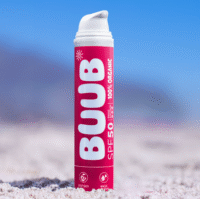
One active, and it is the right one. Non-nano, uncoated at 25%. Non-nano means the particles are too large to pass the skin barrier, so there is no systemic absorption route — the mechanism that makes the six chemical filters a question is simply not present. Uncoated matters too: many mineral sunscreens wrap their zinc in dimethicone or silica to improve the feel, and BUUB doesn’t.
The animal choices are deliberate, not incidental. Candelilla wax explicitly replaces beeswax, and the hyaluronic acid is produced by fermenting plant sugars rather than by the animal-derived route still common across the industry. Two decisions that cost more and are easy to skip.
What lifted the score most was the transparency. BUUB publishes every ingredient with what it is, how it is made and what it does — including the unglamorous stabilisers most brands bury. That is rare, and it is precisely the behaviour Shake exists to reward.
Where it lost marks. Packaging is not disclosed anywhere on the site, so recyclability can’t be credited. Coriander oil is a contact sensitiser for a small minority. And the “100% organic” claim can’t be literally true — zinc oxide, purified water and sodium chloride are minerals, not organic matter. Imprecise marketing on an otherwise notably honest product.
Shake earns a commission if you buy through this link, at no additional cost to you. The commercial relationship is never an input to a Shake Score — BUUB was assessed against the same four pillars, by the same standard operating procedure, as every other brand we publish.
Aligned
Three things we have asked BUUB to confirm
We publish our rather than waiting until everything is tidy. None of these is an accusation, and all three could move the score upwards.
- Grapefruit seed extract. Commercial GSE has a documented history in the literature of owing its antimicrobial activity to synthetic preservatives present as contaminants. Clean GSE exists, and BUUB may well be using it — we have asked for the supplier’s certificate of analysis.
- SPF 50 verification. A mineral-only formula reaching SPF 50 is achievable at 25% zinc, but it is a high claim. We have asked for confirmation of in-vivo testing to ISO 24444 or equivalent. Burns are the failure mode, so this one matters.
- Packaging. Material and recyclability aren’t published. Confirming them would likely lift the Gaia score.
Still being researched
Three slots, open. We publish a brand when it has been through the full four-pillar assessment and not before — an empty space is more honest than a name we haven’t earned the right to print. If you know a sun care brand that should be here, tell us.
Under research
Currently being assessed against People, Animals, Gaia and Frequency.
Under research
Sun care that earns its place here is rarer than the shelf would suggest.
Under research
Know one we should be looking at? We read every suggestion.
Chemical filters go into it.
That is the whole argument, and it is a smaller one than the internet would have you believe. Nobody here is telling you to throw out your sunscreen or to stare at the sun. The position is duller than that: don’t burn, know what you are putting on, and notice when “we haven’t finished testing this” gets quietly translated into “this is safe.”
Shade is free. It also works. And this is your written permission to buy the ridiculous hat.
Words on this page
We would rather explain a word than avoid it. Tap any dotted word above, or read them here.
- Open Questions
- Things we have asked a brand and not yet had a checkable answer to. We publish them rather than waiting for a tidy page.
- Fragrance (parfum)
- On a label, a single word that can legally stand for a blend of many ingredients, because the recipe is treated as a trade secret. You usually cannot tell what is in it.
- Reef-safe
- A marketing phrase with no legal definition. It usually means a sunscreen leaves out oxybenzone and octinoxate.
- Zinc oxide
- A white mineral that sits on the skin and reflects and scatters UV light. It protects against both UVA and UVB.
- SPF
- Sun Protection Factor — how well a sunscreen protects against UVB, the rays that cause sunburn. It says nothing about UVA.
- Nano
- Particles so small they are measured in nanometres — billionths of a metre. In sunscreen and toothpaste, “non-nano” means the particles are kept larger.
- Silica
- Silicon dioxide, the mineral in sand and quartz. In toothpaste it is the gentle abrasive that polishes teeth.